AI
Subtle Improvements to Oracle Analytics AI Agent Knowledge Management
When I first wrote about Oracle Analytics AI Agents a couple of months ago, one of the key capabilities I highlighted was the ability to upload documents that provide contextual knowledge to the Oracle Analytics AI…
When I first wrote about Oracle Analytics AI Agents a couple of months ago, one of the key capabilities I highlighted was the ability to upload documents that provide contextual knowledge to the Oracle Analytics AI Agent.
These documents allow the AI agent to interpret concepts and metrics correctly when answering analytical questions.
While working with the feature again recently, I noticed that Oracle has introduced a couple of additional configuration options in the March 2026 Oracle Analytics Cloud update when uploading knowledge documents.
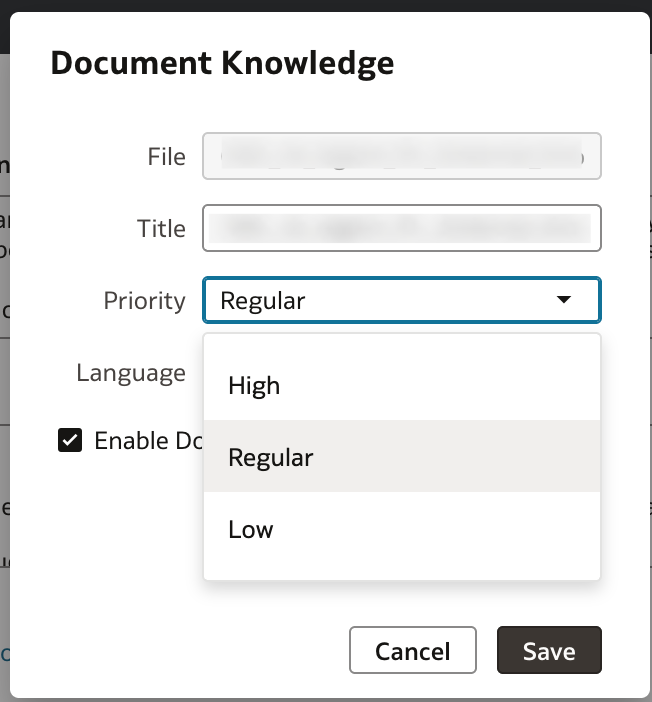
Setting document priority when uploading external knowledge. |
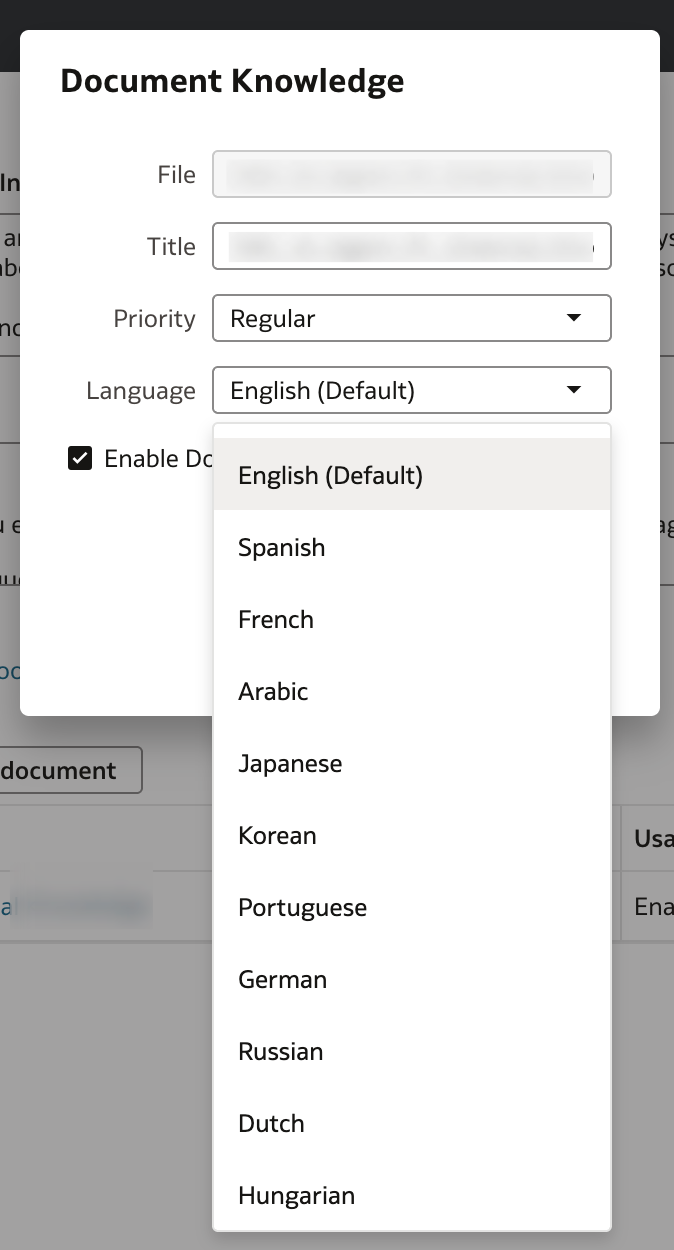
Selecting the language associated with the knowledge document.
|
There is moe detail about these new configuration options in this Oracle Analytics video.
These include Priority and Language, which provide more control over how knowledge is retrieved and used by the AI agent.
Document Priority
When uploading a document, you can now assign a priority level.
The available options are:
- High
- Regular
- Low
This setting influences how strongly the document is considered when the AI agent retrieves knowledge to answer a question.
In practice this allows administrators to guide the agent towards more authoritative sources. For example, organisations may choose to assign higher priority to internal documentation or curated domain knowledge while leaving supplementary material at a lower priority.
This is particularly useful when multiple documents are attached to an agent in which case, this setting can be used to give certain documents precedence.
Document Language
Another useful addition is the ability to specify the language of the knowledge document.
Oracle Analytics supports multiple languages including English, Spanish, French, German, Japanese and several others.
Setting the language metadata helps the agent retrieve the most appropriate document when answering questions in different languages.
For organisations operating across international teams, this makes it easier to maintain multilingual knowledge sources for a single AI agent.
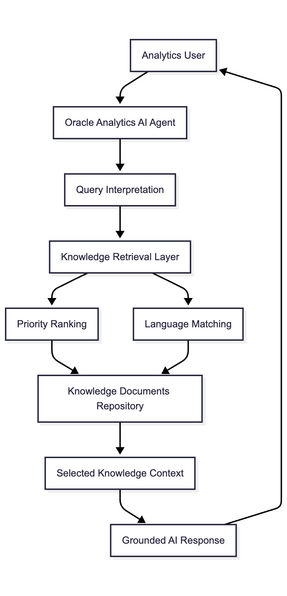
Why These Enhancements Matter
At first glance, the Priority and Language settings may appear to be minor configuration options. In reality, they represent an important step towards better governance of enterprise AI.
As organisations begin to rely on AI agents to answer analytical questions, the quality and relevance of the underlying knowledge becomes critical. Without clear control over which documents should take precedence, an AI agent could retrieve information from less authoritative sources, potentially leading to inconsistent or misleading responses.
The introduction of document priority allows organisations to guide the retrieval process. Trusted internal documentation, curated knowledge bases, or officially governed metrics definitions can be prioritised over supplementary materials. This helps ensure that responses generated by the AI agent remain aligned with the organisation’s approved definitions and analytical standards.
The language setting also plays an important role in global organisations. Many enterprises maintain documentation in multiple languages across different regions. By tagging documents with the correct language metadata, Oracle Analytics can ensure that the AI agent retrieves the most relevant knowledge for the user’s query.
Taken together, these enhancements move Oracle Analytics AI Agents closer to a governed enterprise AI model, where organisations can not only provide contextual knowledge, but also control how that knowledge is prioritised and interpreted.
For architects and data leaders, this reinforces an important principle: successful AI is not just about models and prompts, but about governed, well structured knowledge.