AI
Why Oracle Beat Databricks, Microsoft and Snowflake in ISG’s AI and Data Platform Rankings
When Oracle announced that it had been named the overall leader in ISG Research’s 2026 AI and Data Platforms Buyers Guide, my initial reaction was probably the same as many people working in the data and AI…
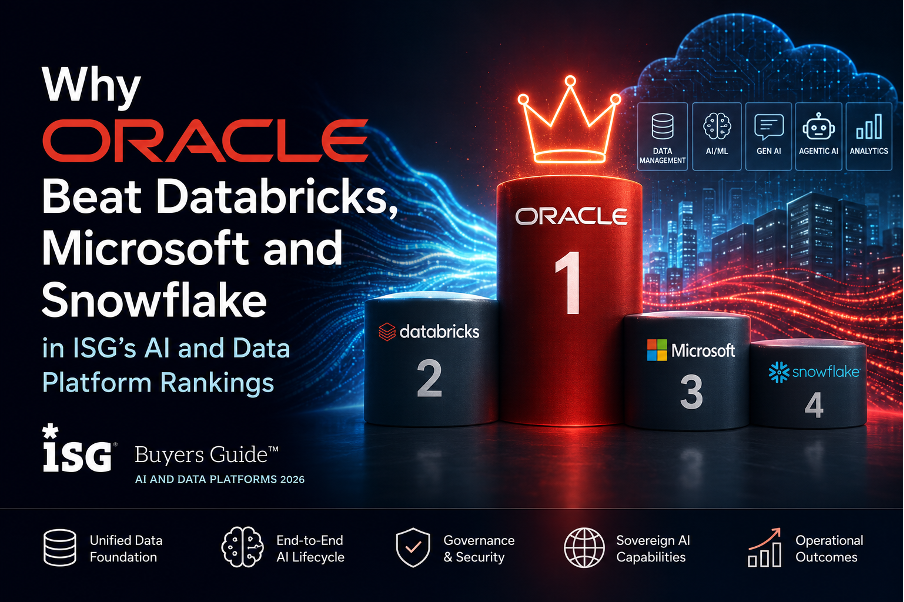
When Oracle announced that it had been named the overall leader in ISG Research’s 2026 AI and Data Platforms Buyers Guide, my initial reaction was probably the same as many people working in the data and AI space.
Really?
Ahead of Databricks, Microsoft and Snowflake?
After all, Databricks has become synonymous with the modern lakehouse. Microsoft has invested heavily in Fabric, Azure AI and Copilot. Snowflake continues to dominate discussions around cloud data platforms.
So, I decided to dig into the report to understand exactly what ISG was measuring and why Oracle came out on top.
The answer is more interesting than I expected.
This Wasn’t an AI Model Competition
One of the first things that stood out was that ISG was not attempting to determine which vendor has the best large language model, the most advanced notebook environment or the most innovative data warehouse.
Instead, the report evaluated what it describes as an AI and Data Platform. The assessment covered a broad range of capabilities including:
- Data preparation
- Data engineering
- Data architecture
- Data persistence
- AI and machine learning modelling
- Generative AI
- Agentic AI
- AI governance
- MLOps
- Sovereign AI
- Analytics
- Deployment and operationalisation
In other words, ISG evaluated the complete journey from enterprise data to production AI applications.
Viewed through that lens, the results begin to make much more sense.
Oracle Didn’t Win One Category
It Won All of Them
The report identifies Oracle as an Overall Leader and, perhaps more importantly, a leader in every major category assessed. Oracle appeared in the leadership group for:
- Overall ranking
- Product Experience
- Capability
- Platform
- Customer Experience
Databricks appeared in several leadership categories.
AWS also performed exceptionally well.
What surprised me was that Microsoft and Snowflake did not appear in any leadership category despite both being recognised as strong performers.
This suggests that Oracle’s victory was not driven by excellence in a single area. Instead, it reflects consistent performance across the entire platform evaluation.
The Importance of Breadth
Reading through the report, a recurring theme emerges.
ISG places significant emphasis on platform breadth and integration.
This is where Oracle’s strategy over the last few years becomes particularly relevant. Historically, Oracle’s reputation was built on database technology, data warehousing and enterprise applications.
Today, however, Oracle offers a much broader portfolio that includes:
- Oracle Autonomous AI Database
- Oracle AI Vector Search
- OCI Data Science
- OCI Generative AI
- OCI Generative AI Agents
- Oracle AI Data Platform (AIDP)
- Autonomous AI Lakehouse
- Oracle Analytics Cloud
It’s also worth noting that while Oracle AI Data Platform only became generally available in October 2025, AIDP is not an entirely new technology stack. Rather, it brings together many of Oracle’s existing data, analytics and AI services into a unified workbench and operating model. The databases, lakehouse capabilities, AI services, governance features and analytics tools that underpin AIDP have been evolving for years; AIDP simply consolidates and surfaces them through a more integrated platform experience.
Individually, none of these products necessarily dominate their respective markets.
Collectively, they form a coherent platform that spans data management, AI development, governance and operational deployment.
That appears to be exactly what ISG was rewarding.
Why This Matters
Most organisations are no longer struggling to build AI proofs of concept. The challenge today is operationalising AI at scale.
That means:
- Managing structured and unstructured data
- Governing data access
- Supporting retrieval augmented generation
- Monitoring models in production
- Controlling costs
- Meeting regulatory requirements
- Supporting sovereign AI initiatives
These are enterprise problems rather than data science problems.
The report repeatedly highlights governance, operational deployment and integration as critical evaluation criteria. Oracle’s traditional strengths in enterprise data management and governance appear to have translated well into the AI era.
The Databricks Question
Databricks remains one of the most impressive platforms in the market. Its leadership position in lakehouse architecture, Spark-based processing and machine learning is well deserved. However, the ISG report suggests that the evaluation extended beyond data engineering and model development.
The assessment considered the broader enterprise platform required to operationalise AI.
That broader scope may explain why Oracle edged ahead despite Databricks remaining one of the strongest technical platforms available.
The Real Surprise: Microsoft
Perhaps the biggest surprise in the report is Microsoft’s position.
Given the momentum behind Microsoft Fabric, Azure AI Foundry and Copilot, many would have expected Microsoft to challenge for overall leadership.
Instead, Microsoft was classified as Innovative rather than Exemplary.
Without access to the detailed scoring breakdown, it is difficult to know precisely why. However, the quadrant positioning suggests that customer experience and operational considerations may have influenced the outcome.
What This Means for Oracle Customers
For organisations already invested in Oracle technology, the report provides validation of a strategy that has been evolving for several years.
Oracle is no longer simply competing as a database vendor.
It is competing as an integrated AI and data platform provider.
That distinction becomes increasingly important as enterprises seek to reduce platform sprawl, simplify governance and accelerate AI adoption.
The organisations most likely to benefit are those looking for a unified approach that combines:
- Data platforms
- AI development
- Agentic AI
- Governance
- Analytics
- Operational deployment
within a single ecosystem.
Why This Report Resonated with Me
One reason I found the ISG findings particularly interesting is that many of the themes highlighted in the report mirror topics I’ve been exploring on this blog over the last year. Oracle AI Data Platform, Autonomous AI Lakehouse, vector search, agentic analytics, AI governance and the convergence of data engineering, analytics and AI into a single operating model have been topics covered in my recent articles. At the time, these felt like individual product announcements and technology developments. Viewed together through the lens of the ISG report, they appear to form part of a much broader strategic direction.
What struck me most was how closely the evaluation criteria align with the challenges I see customers trying to solve in real projects. The conversation is rarely about finding the best AI model in isolation. It is about governing data, operationalising AI, managing costs, maintaining security and delivering business value at scale. From that perspective, Oracle’s strong performance feels less like a sudden emergence and more like the culmination of a strategy that has been steadily taking shape over several years.
Final Thoughts
The most interesting conclusion from the report is not that Oracle beat Databricks, Microsoft or Snowflake.
It is why.
- Oracle did not win because it has the best AI model.
- It did not win because it has the best notebook environment.
- It did not win because it has the most popular data warehouse.
Oracle won because ISG evaluated the entire enterprise AI lifecycle and Oracle was the only provider that consistently scored at the highest level across every category.
Whether you agree with the rankings or not, the report highlights a broader shift in the industry.
The conversation is moving away from individual AI tools and towards integrated AI and data platforms.
On that measure, Oracle’s strategy appears to be paying off.
Looking back at the topics I’ve covered recently, from AI Data Platform and Autonomous AI Lakehouse through to agentic analytics and enterprise AI architecture, a common theme emerges. The future is unlikely to belong to standalone AI tools or isolated data platforms. It will belong to integrated ecosystems that bring data, analytics, governance and AI together. Whether Oracle can maintain its lead remains to be seen, but this report suggests it is currently one of the vendors best positioned for that future.